Tuesday, January 31, 2012

Grid Sampling of Soil


Grid soil sampling evolved after GPS became available to find your spot in the field over and over again. 2.5 acres quickly became the standard for a grid which is ten rectangles in a 50 acre field. Since most 50 acre fields aren't square, you have some larger than others, but you get the concept.

For us gardeners, most of our gardens are less than 2.5 acres so we are farming very tiny grids. Our 40 by 50 garden is only 2000 square feet, a tiny patch of ground compared 4,360 square feet in one acre. We can sample very accurately and get fairly reliable results and recommendations from our soil test.

I said "fairly reliable" because even a scientific soil test can seem to be a "a shot in the dark" as to what is really going on in a soil profile to cause plants to thrive or struggle. It's the best idea man has come up with in the last 100 years of farming so we start there.

Larger acreages are much more complex. Many farmers cover 2,000 acres in a year to make a living for a family of four. Some still make a living on a few hundred acres and it takes some many more thousands to make it. My subject today is why or why not grids?

I do not use grids. I still pull about one sample per acre and an 80 acre field that can be farmed by breaking it into 2 or 3 distinct soil types and yield levels can be treated as separate fields inside one boundary. Many farmers were sold or chose to grid sample their farms in an effort to increase yields and/or decrease costs. I have not seen it to do either very often, if at all.

Still the subject comes up often and my friend Joe Nester, owner of Nester Ag Consulting in Bryan, Ohio made a great post that explains one man's quest to prove grids right or wrong.

"I've been working with soil tests and trying to figure out the best way to be representative, so you can make good nutrient decisions for over 35 years. Grid sampling came out when GPS was made public, before yield monitors. Although we thought we were collecting lots of good data, turned out we were just collecting lots of data that was not very representative. It is actually point sampling, in most cases, 6 or 8 probes taken at the center of the grid. When the data is returned from the lab, it fills the boundary of the grid. Then most software divide each grid into 50' x 50' cells for application, and using mathematical equations, (several theories to chose from), the P & K is varied in each cell based on the theoretical value, that was determined by the theoretical values of the cells next to it. This system creates more variability than was normally present in the field to begin with. Over 97% of the data for 50' application cells is estimated in a 2.5 acre grid. You only sampled 1 of them. When it first came out, it was in conjunction with the invention of the Ag-Chem Soilection machine, and was used to sell the service of that equipment and differentiate from competitors that did not have it.

Even during that time, we were also using hand drawn maps, separating high ground from low ground, sands from clays, and high exchange soils from low exchange soils. We were having farmers spot treat for lime, even without VRT(Variable Rate Transfer) equipment. Then came Windows CE units, then iPac's, and handheld computers that we could hook GPS to. We started driving boundaries, and driving the lines that separated the soil type zones in the field, using the irregular shaped zones to sample and make recommendations, and spreading lime by those maps. Then came the yield monitor and digitized soil surveys, and these were fantastic additions to soils management.

Now- we can combine information from the crop, even normalize yields from different crops, and let the crop tell us where the soil changes. The digitized soil survey is decent information for how they were developed, but it is black and white- you're either in a soil type, or cross the line, and you're in a different soil type. It really doesn't happen that way in the field- there are transition zones where 1 soil type blends to another, and well calibrated yield maps show that.

So having had the opportunity to work with all the above, on lots of acres and lots of soil types, my #1 choice is zones developed from yield maps (well calibrated maps so they show accurate variation in yield), with input from the farmer, and input from the practicing agronomist. If you don't have a yield monitor, use digitized soil surveys, elevation data, and perhaps aerial imagery in crop, and veris data. (But think strongly about a yield monitor, because it can give you some very valuable data about your farm and your practices.)

Precision ag has had a different rate of adoption across the corn belt, with some hot spots having much more experience than others. Those early adopters have moved on from grid sampling to management zone development, and the NRCS and most land grant universities are even agreeing with them. You will seldom find an independent consultant that uses grid sampling anymore. Unfortunately, grid is totally driven by the computer, and does not include input from the farmer, the agronomist, or the crop being raised on the soils.

Yield zone management will be driven by the 2 most important factors in raising a crop: soil type and water holding capacity of those soils. A great blueprint to manage nutrients, lime, and plant populations by. I would also sample at least every other year- it's not exact and you need to keep building representative data. That was another pitfall of grid- so much was spent in one year that farmers tried to live 4 to 5 years off 1 testing cycle. With yield-zone management, and evaluating fields of progressive farmers, you will find that the lower yielding areas have the highest P & K. This is due to non-removal of blanket applications, and the real yield drop is more than likely due to drainage or lime needs. When those areas are found, corrections can be made if possible, and then you can harvest the P & K that is already present in those zones, and have dollars to spend elsewhere."

There you have it. I much agree with Joe's post on Crop Talk. What do you think?

Ed
Winkle

Monday, January 30, 2012

Gorges' Grouse


To my new Gorges' Grouse friends, greetings! Isn't it funny how one little post can intertwine us all together? The marvels and mystery of the Internet is amazing!

For those of you who haven't read, I am 62 years old and married to LuAnn who was raised on a farm in New York and raised her family on a farm there. We met thanks to Agriculture Online where I was posting on the Crop Scouting page in the mid nineties.

I am a retired teacher of agriculture and served seven years as a county extension agent. I started HyMark Consulting in 1994 when my boys needed a Supervised Agricultural Experience Program in their FFA Chapter and LuAnn and I have operated it as an LLC in Ohio since 2000.

We bought a farm in 2004 which became my farming and experiment location while she works as CEO of a local non profit that helps ex-offenders get back into the world of work. We love to travel and we lead very interesting lives. Our love for life through no-till farming has taken us to Europe and New Zealand and across the states. We have camped in the lower 48 and part of Canada and will soon visit our 50th state together, Hawaii.

If you browse my blogs from the last three years, you can see the gardening, farming and travel stories we found. I am quick to test new farming methods before I recommend them to others.

One I have learned over my life is the Albrecht soil testing method. I would recommend all my farming and gardening readers to read this link at your leisure. I sample my soils like it is described here. It is good to start here with any gardening or farming project so we can get a "snapshot" of what your soil looks like in order to formulate a plan to grow better crops.

Readers from all over the country send me their analyses to get my opinion. I do this for a fee for farmers and larger tracts but usually just give advice to someone who sends their labs analysis or recommend someone else they can talk to solve a problem or increase production and quality. The ones out of the country are a little challenging to equate from Metric to English!

So let's start there, you have plenty of reading to do in the links and my past blogs on many different subjects. Many of them have to do with gardening, farming or travel, so read and ask away!

To Gorges', thanks for asking my question and giving me some answers. As Budde pointed out, my blog is written more ilke my old Extension Newsletters I used to write and don't necessarily question the reader to comment. Blogspot did have a comment problem last week which seems to have been fixed temporarily, at least.

Welcome to all my new readers and let's help each other live a better life through our Internet exchange!

Sincerely,

Ed Winkle

Sunday, January 29, 2012

Comments on Traveling


My friend Lucas(I have been to his farm) posted his observations on traveling in the Cafe and I thought it would be good to share here today.

"Three weeks ago we traveled to the Notill conference in St. Louis. We flew. You get there early so you can be demoralized by a metal detector and no drinks through the check point because they are connected with all the food joints inside so they throw away what they can so you have to buy a 5 dollar drink , $2 pack of gum, $5 sandwich. Because what else can you do but eat when you are there two hours early. Oh then you can't have a direct flight you have to go for a 40 minute ride to the next feed trough (airport) and another 1 and half wait. Heck might as well buy another $5 dollar drink oh and there is all those danishes and cinnabuns. Finally get to the last flight . Takes all day to travel by plane.

Then I did it all over again this past week to Des Moines to go to Ames Iowa For some Agleader training so I got to add the joy of a rental car which I picked a compact because it was cheapest. I get there I was concerned I am 6' 3" all I could see was some little toy, I ended up with a Chevy Impala so not to bad. I was there for five days last training day wasn't over till 5 Thursday so I get to pull my hair out cause I couldn't get a flight back east until Friday morning. Did I mention I had my fill of flying for awhile."

Another friend Omar(he has been to our home) replied "I've got to the point where my cutoff point for driving is 15 hours. In other words, a full day. That's because a flight to almost anywhere is going to cost me a day anyway. For exactly the reasons you stated.

It takes me under an hour to get to Toronto, but I have to allow for two in case the traffic is bad. Then, I'm supposed to be there 3 hours ahead for international flights. Usually, you sail through, so that's 2 hours plus the remainder of the driving time I didn't use to kill. Or, you don't sail through so you have a couple hours of stress worrying whether you'll make your flight. So you are up to four or five hours and the plane hasn't even left the ground. I may technically have saved a bit of time flying, but there's really nothing else I'd be able to do on the travel day anyway. I might as well be driving and seeing a bit of country.

Since you can't carry anything on (say shaving supplies) unless you pay for the mini-sized containers ahead of time (assuming you remembered to buy them), you end up checking stuff in, but now you have to pay extra per bag to do that.

If you do make it through easily, there's that challenge of what to do. Sit in a bar? Well, you could browse the internet, but most airports nail you for 10 bucks for a 24 hour login to the internet. Knowing I'll only be there for a couple hours, that just doesn't match my idea of good value.

My stress level is way down when I drive. It's amazing how far a person can get with a full day of driving."

My observations were "Very good observations, Lucas, I agree. Just reading that makes me see why I don't like to fly, doesn't fit my farmer mold. But I do love to travel and meet new people and see new things so it's put up with or find something much slower.

I am sure the seasoned traveler doesn't like it much better and the airport is a center of angst and frustration, just ripe for a blow up like we see on TV news. Homeland Security is a joke to me, padding down some old lady who would like to blow the person up doing it and letting some suspiscious character walk on by who looks like they intend to. But no that's racial profiling or whatever. What a joke, no common sense.

This modern travel shows the epitome of society, mixing all these people together from everywhere and every possible background.

Cruising is in the news but it's probably safer than walking down some city streets, definitely safer than automobile or plane and statistics show that. That captain might really be a hero or really lucky(blessed) because he almost sent 4000 people to the bottom of that drink. That ship teetering over that 600 feet deep ledge has been something to watch. Geraldo was pretty intertesting on the subject last night, we never watch him and it was so melodramatic it was sickening but it was very interesting.

You are right though, nothing like getting home and walking around on your own farm."

What are your recent observations from traveling?

Ed

Saturday, January 28, 2012

Farmer's Share


I went to a Farmer's Share breakfast this morning where breakfast is served for the cost of what the farmer gets from the production of the raw products in the meal. This is usually sponsored by a Farm Bureau group in our state and it was this morning, too, the Clermont County Farm Bureau.

Pancakes, sausage, scrambled eggs, milk, juice and coffee cost 50 cents. That is about what the farmer get's as his share from the sales of farm produced commodities that are shipped, processed and prepared for our meals.

They had little paper towers of information about farming in Ohio. Ohio has 4 million hogs raised by 3700 farmers. We are number two in egg production and in the top ten states of just about every category of grain and livestock production. Ohio has always been a prominent farming state although the message has been lost over my lifetime.

There are about 45,000 farming operations in Ohio producing about nine million acres of grain and other crops. Ohio almost always has more acres planted to soybeans than to corn. The last time there were more corn acres than soybeans was 1986. The last time Ohio had over a million acres of wheat was just 2008 and there were still 3 times more corn or soybean acres than wheat.

Acres of oats, grapes, potatoes, and tobacco continue to decline over time. Other states have more suitable weather and soils for those crops except tobacco which has declined from health concerns. US production of tobacco has declined form 2 billion pounds in 1975 to 1.2 billion pounds in 2001, or 42%. Ohio reflects that, too.

Ohio is 11th in the number of farms so that goes with it being in the top ten states in production of most agricultural commodities.

Agriculture is still the backbone of Ohio's and the country's economies which makes farming activities very important but one that is easy to take for granted.

What would my 50 cent breakfast cost in your neighborhood? Here it would be $5-10 plus tax and tip.

Ed

Friday, January 27, 2012

Flood

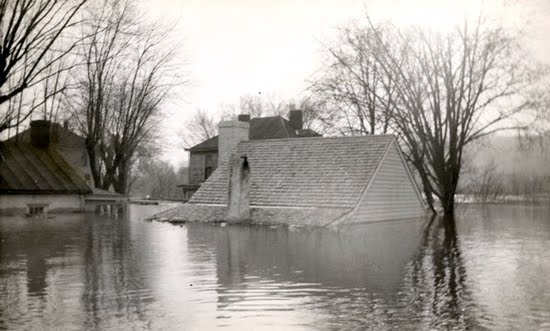
This is what U.S. Grant's birthplace looked like during the Great Flood of 1937 near Point Pleasant, Ohio.

In 1937, it started raining in southern Ohio and never stopped for 30 days. By around this date 75 years ago, the Ohio River crested near 82 feet at Coney Island near New Richmond, Ohio and we still marvel at that marker way in the air whenever we visit Coney Island today.

I thought it would be a good time to call Uncle Roy and see how he is doing so I called yesterday. I emailed this message to my family last night.

"I called Uncle Roy today to see how he was doing. I asked him if he knew what he was doing this day 75 years ago?

He would have been 8 years old then, living on the farm in Sardinia. I gave him a hint on the Great Flood and he said it flooded almost every year there but he remembers the water was over the Slab Camp bridge on Hamer Road and you couldn't get to the Stevens Farm on Stevens Road.

He told me the floods in 34 and 36 were nearly as big and the one in 36 was bigger in Pittsburgh. The flood of 37 crested around 81 feet in Cincinnati and a million homes were lost from Pittsburgh to Cairo, Illinois.

He said after the water went down some, Grandpa took them on a ride to Ripley where they saw a house that was washed off its foundation and sitting on its roof when the flood went down! We wished we had a picture of that and Winnie took all the pictures then but he didn't think they got one of it.

He said the flu was going through the house about that time and he and his sisters were in bed, ill from it. He said they listened to the big radio and kept the fire going and that was about it.

I asked if it was hard to feed the livestock? Dad was 22 then and a middle child with 4 older sisters and 3 younger sisters and Roy. We agreed nothing was that easy then, dry or wet."

I try to read the blogs you will find under my profile. I probably read The Lazy Farmer the most, George's Grouse, and Ralph Goff's and many others whenever I can. George's Grouse is from West Virginia and had a good blog on the '37 Flood.

Lots of people have been talking about it this week as it's been on the local news and it is so wet here it makes you wonder if we would have the same thing without the flood controls put in with WPA in the Great Depression. This area has seen up to 75 inches of rain in the last 13 months so the tributaries haven't been dry for a long time.

Uncle Roy devoted his career to soil and water conservation and flood projects that have kept our area "high and dry" compared to the '37 Flood.

I know it is drier west of Cairo, Illinois and I hope you find yourself "high and dry" today but get the water when you need it this year.

Ed Winkle

Thursday, January 26, 2012

Am I An Introvert?


I saw a piece on the news talking about Susan Cain's new book called Quiet. It's about the traits introverts and extroverts exhibit and great leaders who lean one way or the other.

I have always seen myself as an introvert, basically was a shy kid who was taught and learned to live outside that shell to function and be happy. I've taken the Myers Briggs Personality Test and it shows about the same thing. I took this test I found this morning and the way I answered the questions, it rated me as 45% extrovert which it called "balanced." That's pretty good for me today.

My mood affects how I feel and thus how I answer questions. The rain is quite depressing again today but I guess it isn't bothering me that much. There is nothing I can do about it, anyway.

The news piece showed the President, Mitt Romney and Ron Paul as introverted and Newt Gingrich and Rick Santorum as extroverted. It showed Pope John Paul and Benedict as introverted and how that can be used for quiet but very strong leadership.

I would assume most farmers lean to introvert behavior but I can think of a few pretty social, loud and boisterous ones, too. Job success doesn't necessarily link to personality traits but they don't hurt and sure can help. You can picture a rancher or a cowboy as being pretty introverted to the point of being a "loner." A fellow who loves to drive tractor all day just uses a different type of horse!

So are you an introvert or extrovert or pretty well balanced?

Ed

Wednesday, January 25, 2012

Planter Clinics


Yesterday Jennings County Indiana Soil and Water Conservation District called to see if I would teach two planter clinics in their county, one February 22 and one the next day. I said yes and both clinics will be in farm shops with planters inside.

I have done these many times before but they always make me a little bit edgy as I am probably the worst mechanic in the room-I have the least mechanical aptitude, just ask my wife who assembles all the stuff we buy.

I know the theory pretty well and have done clinics from Maine to Alaska to New Zealand. It's a good thing my friend Andy Vance was doing an article on the subject so I have a recent base to work from.

Here is what Andy wrote:

Corn & Soybean Digest – January 2012

Gearing Up For Planting

“It all comes down to the planter. If you don’t get it in the ground right the first time, nothing else matters.”

That simple philosophy is at the heart of what crop consultant Bill Lehmkuhl says is one of the most important parts of the crop cycle: getting ready for planting season. While farmers in many parts of the Corn Belt planted the 2011 crop later than ever, and subsequently shelled corn well into December, he says getting ready to plant the next crop should never be far from top of mind.

“Be aware that accurate spacing and the planter is where it starts,” he advises his clients across western Ohio. “Yield is not a function of plant population, but of ear count. That final ear count is what drives yield. If you plant 32,000 seeds, you’d better have 32,000 ears.”

He says the process starts by inspecting the planter “from hitch pin to closing wheels.” Some aspects of a thorough tune-up can easily be done in the shop, e.g., checking for wear items like parallel arms, lines and hoses, but some work will need to be done in field, like ensuring the planter is level while in motion.

The key concept behind planter maintenance, from Lehmkuhl’s perspective, is creating the ideal seed trench. That includes checking for proper contact on disc openers (anywhere from 1 to 2.5 inches, depending on planter model), keeping uniform down pressure on each row unit, and having the proper attachments in place.

“I don’t care what scenario you’re in tillage-wise, row cleaners on the planter are a must from the standpoint of smoothing the ride out for that row unit and seed meter by moving that residue aside,” he explains. “When it comes to emergence, I want to see everything up in that field within 48 hours. The first time you see corn spiking up through, I want it all up within a day or so, and you need uniform seed depth and placement to make that happen.”

Rain Makes Grain, but Too Much of a Good Thing…

Because many parts of the Corn Belt received excess precipitation during the 2011 planting and harvest seasons, a high percentage of fields will be in rough shape when the time comes for planters to start rolling this Spring. The temptation toward what one agricultural engineer calls “recreational tillage” could make a bad situation even worse.

“Many farmers were unable to get back in the field after harvest because of the rains,” says Randall Reeder, an associate professor emeritus in Ohio State University’s Department of Food, Agricultural and Biological Engineering. “Even long-term no-tillers had ruts and compaction issues this year.”

Comparing soil conditions to those seen in 2009, Reeder cautions that the best course of action when it comes to tillage this year may be no action at all. “You don’t want to make a bad situation worse by performing deep tillage on wet soils because it destroys the soil structure,” he explains. “If you do tillage you have a looser soil structure, and if we see more rains this spring, that will allow even more compaction issues.”

The cumulative effect is that tillage begets tillage, meaning that by attempting to correct ruts and compaction issues too quickly, farmers could unintentionally create even more rutting and compaction issues later.

Emphasizing the benefits of controlled traffic, Reeder recommends farmers use overly wet conditions as a learning opportunity, and to consider the benefits of continuous no-till, which can include strip-till ahead of corn.

“Do the least amount of tillage necessary to get the ground ready for planting,” he advises. “Often a light, shallow tillage operation can smooth out ruts and create a surface ideal, or at least acceptable, for planting.”

Accept Murphy’s Law, and Prepare a “Plan B”

For Paul Reed of Washington, Iowa, the best way to prep for planting season is to figure out what can go wrong, and have a game plan in place that assumes if it can go wrong, it will go wrong at some point.

“Along with going through all the nuts and bolts things, we follow a simple management rule: figure out the three worst things that can happen,” Reed says. “We always have a Plan B so that if we lose a system or monitor we can continue planting and aren’t stuck on the end rows waiting to get on the phone with a service tech. As our equipment has gotten more complex, so have our problems.”

As one example, Reed says that while his operation relies on GPS and automatic steering, each planter still has mechanical markers in the eventuality that the GPS system goes down. Planting can continue using markers, rather than stalling while a technological solution is found.

The Reed family keeps detailed notes on problems or challenges uncovered during the planting season, and incorporates those records into the preparation for the next season. By focusing on what did go wrong, they improve planning for what might go wrong in the future.

“The name of the game is to keep the wheels turning to take advantage of a limited planting window,” Reed says. “Crops yield by planting date, so you have to take advantage of the planting days available. If you have only 10 or 12 days in an ideal planting window, being able to keep rolling is a big deal.”

He advises systematically checking each system on the planter, from hydraulic and air pressure systems to fertilizer and seed delivery components, looking for wear items that need replaced prior to planting. While conducting that basic planter maintenance, take stock of what parts, systems or monitors are likely to go down at some point during planting, and have replacements on hand.

“Every one of those systems can and will have something go wrong,” Reed says. “How well and how quickly you can overcome those problems is paramount to keep planting.”

-30-

SIDE BAR

Making a List and Checking It Twice

Christmas may be over, but Ohio-based crop consultant and blogger Ed Winkle advises taking Santa’s advice when it comes to planter preparations.

“Tear apart the planter today,” he says. “We tore our planter apart three times during all the rain last year, and we found something every time. We knew the planter so well that as soon as we had a breakdown, we knew where it was and how to fix it with no down time. The worst thing you can do is drag the planter out of the barn and try to go plant.”

With that in mind, Winkle shares his planter-prep checklist:

Go through each row unit piece by piece.
Go through the seeding mechanism, and match the planter to the seed size you are getting.
Go over all stress parts, as well as the frame, wheels and bearings. “You think the part isn’t worn out, but it is. Replace it. You can’t afford to stretch parts too far anymore.”
Go through hydraulics with books and gauges.
Go through 12-volt system front to back.
Go through electronics, including GPS-related modules and monitors.

What do you think, O Ye planter wizards and wannabe's? The planter in the picture is a modified Kinze after one of my talks ten years ago and still ticks like a clock after years of maintenance and thousands in profits.

Thanks,

Ed Winkle