Thursday, September 4, 2014

The Bachelor

"New way to find a farm wife?? Iowa Farmer Chris Soules has been named the latest star of TV show "The Bachelor".

http://www.farms.com/FarmsPages/ChatDeshBoard/ChatThreadView/tabid/...

Good luck Chris! I hope she can drive a tractor!!"

Our friend Suey in Illinois gave a great reply,

"Have to appear with no makeup.
Dirt under their  manicured fingernails.
Sort livestock together.
Catch corn on the go.  While trying to decipher hand signals.
Fix supper and wait for him to show up.    Or try to find the right field to deliver the meal to.
Send her on a parts run.   So much easier with cell phones.
Small town church.
Attendance at high school football or basketball game.
Wash and wax  a tractor or truck  and clean out the cab.
Scoop corn.
Pick the one that can understand the gps and autosteer  and help fix them. "

Now, I don't believe in choosing your life's mate like they do on this program but I doubt it's any worse than what many of us did.  It's too glamorous and public but it sure is a drawing card!

The young man does remind me of my Iowa farmer friends and I wish him luck.

Ed Winkle

Wednesday, September 3, 2014

Feeding 9 Billion People

I found this piece that I think originated from Ray Archuleta in the Grazing News.  It goes right with what I am working on and have seen on various farms this summer.

With improved soil health, production will increase. Not all at once, but within 3-5 years, soils that had been farmed with heavy use of chemical inputs (fertilizers, pesticides) will be more productive with fewer inputs, cycling nutrients more effectively, and protecting crops against pests and diseases.
Here are seven, simple steps we can take to increasing production by farming for soil health instead of yields.
Root Exudates
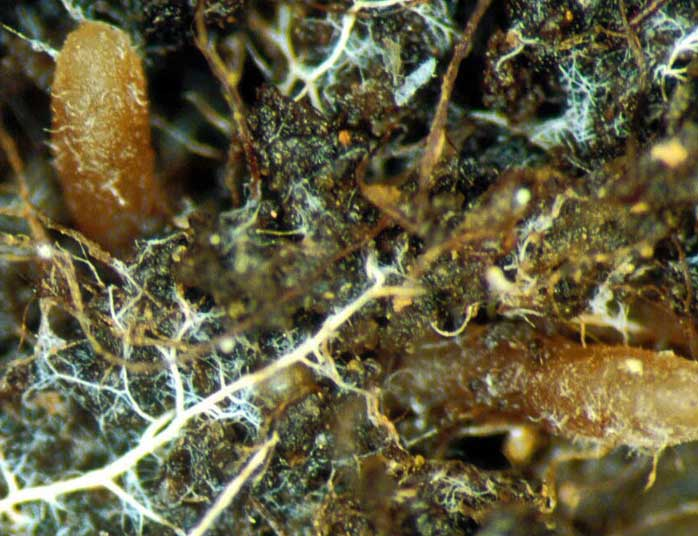
This enlarged picture shows all the creatures living in the soil with the roots. Plant roots send exudates (sugars and other polysaccharides) into the soil to feed microorganisms. Root material and cover crop residues also feed worms.
1. Keep the soil covered.
Cover crops are a must. Only a small percentage of farmers use them, and that’s a shame. Cover crops’ roots provide exudates that feed microbes, and microbes keep the soil alive. Not to mention that cover crops lead to increased yields and reduced fertilizer costs.  It’s a win-win, we might say.
Here are some On Pasture articles about cover crops:
•  Science Backs Profits from Grazing Cover Crops•  The $200 Cover Crop Bump
2. Avoid Tilling.
Tillage provides some benefits, and is sometimes needed. But although it may aerate lower soils, it reduces aggregation, speeds up organic matter decomposition, and reduces microbial populations in the surface, where most of the action is.
Here’s what we’ve found about the results of one form of pasture tilling:
Keyline Plowing:  What Is It? Does It Work?Keyline Plowing Gets You 522,270 Worms for $280
3. Inoculate.
Another idea may be to inoculate your soil with biological inoculants to increase the number and diversity of soil organisms present. Be careful, though, because there is plenty of snake oil out there. Make sure that you are reaching for biologically-based products, and try them out on a small area first to see if they are worth the money and time.
Inoculation is good when you’re introducing a new plant/crop and can be as easy as adding a cupful of inoculant to a whole bag of seed.
4. Reduce Toxicity
Avoid applying all chemicals that might kill microbes. This may include chemicals designed to target one pest species, but may unintentionally harm other species as well. Prophylactic use of antibiotics can mean that livestock are excreting antibiotics that then harm soil organisms if they don’t break down completely.
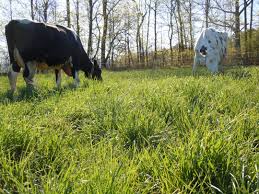
Here's a well-managed, diverse pasture courtesy of UVM.
Here’s a well-managed, diverse pasture courtesy of UVM.
5. Avoid Monocultures
Diversity is key for soil biology. Diverse crops mean that you are feeding the soil organisms a diverse menu of carbon. Diversify your hayfields, your pasture, your cover crops. Your soil will be healthier and your operation will be more resilient in the face of drought, or other weather problems. Have fun with it, and try new things.
6. Practice Better Grazing Management
Avoid overgrazing (and increase diversity). Jeff and Ray do a lot of traveling across the US, and both have seen so many pastures that are straight tall fescue, and so many places where the herd should have been moved- last week! Overgrazing can mean waiting a year to recover, or five years or more in more brittle environments. Manage grazing efficiently, to take what is there, and to give land time to recover. Try seeding in some crops for fall or spring grazing to add diversity, legumes for nitrogen, and to provide a grazing option that might not have been there.
7. Innovate
There are so many things to try. Read about them, or ask your NRCS, Conservation District or Extension staff about what’s new on the horizon. Find out about about overseeding with new plants, try new cover crops. Try out chicory, radishes, clover, turnips. Add peas to the mix. There are many new hybrids with valuable traits that might be worth the extra cost of the seed. Keep on trying new things, and keep adding diversity, pay attention to outcomes and keep notes so you can figure out what works best, and you’ll find new ways to be successful.

It works!

Ed Winkle

Tuesday, September 2, 2014

September

September is a always a busy month here.  We have the Highland County Fair this week and the Corn Festival this weekend.  They both draw good crowds.  Then we have the Ohio No-Till Field Day next week, the Farm Science Review the week after, and the popular Brown County Fair the last week of the month.

Two of my younger farmer friends have invited me to their Farm City day on their farm but they are both the same day!  I would like to support them both.

I've never been to the John Buck Farm at New Bloomington, Ohio next week but I guess I get my chance to!

Ohio No-Till (Summer) Field Day
September 9, 2014
John Buck farm
7632 Wildcat Pike
New Bloomington, Ohio
(western Marion County)
Agenda:
8:00: Registration:(visit exhibitors and no-till machinery; donuts & drinks)
8:55 Welcome Dave Brandt, President, Ohio No-Till Council
9:00 Secrets of success for no-till corn and soybeans
Barry Fisher, Indiana NRCS State Agronomist
9:45 Putting the entire soil profile to work for you
Hans Kok, Coordinator, Indiana Conservation Cropping Systems Initiative
10:30 Q&A discussion
10:45 BREAK
11:00 The importance of continuous no-till and ideas to make it even more successful
Ed Winkle, Owner, Hy-Mark Consulting, Martinsville, Ohio
11:45 Discussion, and introduction to afternoon speakers
12:00 LUNCH (Comments from All-Ohio Chapter SWCS President, Clark Hutson
1:00 (Concurrent) Gardening with Cover Crops
Ann Brandt, Walnut Creek Seeds
(Followed by seeing the “garden” cover crop plots in the field)
1:00 Field events
1:15-3:45 (4 stops in the field; 30 minutes gross time each)
1. Precision Manure application Brad Mattix2. Cover crops (above ground benefits) David Brandt, no-till farmer
3. Cover crops / soil pit Hans Kok
4. Soil pit George Derringer, USDA-NRCS
3:45 END

I hope to get to visit with you at one of these events!

Ed Winkle

Monday, September 1, 2014

Good Friends

Good friends are invaluable.  I am lucky to count more than a handful.  Actually, I am very blessed because "luck" is a blessing in disguise.  Maybe we need more training to identify our blessings?

I've talked about my involvement in Ohio State LEAD Class IV many times.  30 of us were selected for a two year, 60 day intensive look at leadership in agriculture.  That took us all over our state of Ohio, California and Western Europe.  It was a very rare and valuable experience for me, one that really has changed my life.

One of my classmates is a close friend and just left our place with a load of wheat on his semi tractor and trailer.  Even though he lives at the other end of the state, we have shared many valuable days together in the last 22 years.  We bounce a lot of ideas off each other.  We share our passions of no-till farming and family and a lot of other good things.

We were able to see a lot of our friends this Labor Day weekend.  Lots of us have the same concerns and are going through similar circumstances because of our age group and profession.

"In his discourse on friendship in the Nichomachean Ethics, Aristotle says: "For without friends, no one would choose to live though he had all other goods. Even rich men, and those in possession of office and of dominating power are thought to need friends most of all; for what is the use of such prosperity without the opportunity of beneficence, which is exercised chiefly and in its most laudable form towards friends? Or how can prosperity be guarded and preserved without friends?" He goes on to say that: "But it is not only necessary but also noble; for we praise those who love their friends, and it is thought to be a fine thing to have many friends; and again we think it is the same people that are good men and are friends."
Have a great Labor Day with your friends, I hope you find them among your family!
Ed

Sunday, August 31, 2014

Grandma, Grandpa Tired

Yesterday our sweep auger broke so grandma and grandpa had to shovel on a semi load of wheat.  I really didn't think we could do it but we did.

We didn't do it by ourselves, we had a smallish 17 year old helping us.  He shoveled like a trooper and was very happy with his "hazard pay."  I don't let just anyone go inside a grain bin but we are down to the last 1000 bushels in a 30 foot bin and you can't get trapped.  You can get sick from grain dust or step into the auger hole but neither of those were much of a threat either.

I don't know how many people still shovel out bins but no one want I've met wants to do it.  We caught the hot weather cooler with a nice breeze which really helped.  I think God was in charge of this whole deal from the day I first walked in my neighbor's field of Lion wheat to certify it, to the day we planted it, to the days we harvested it.

One good thing it did is help grandma see what good seed it is.  She said that was some of the prettiest seed she'd ever seen in her life and she started shoveling as a child like it did.  Not every farm wife would enthusiastically volunteer that job like she did.  It rekindled my deep respect for her farm background and everything we've through together for 15 years now.  Heck of a way to build your relationship, isn't it?

Today we are both stiff and sore and will probably moan a little but I have a great sense of thanks due to our accomplishment.

Once again God took something bad and made something good out of it.

I wish I had a picture to show you but we were kind of caught up in the moment yesterday and taking pictures was not on our agenda.

We didn't think shoveling wheat was either 24 hours ago.

Ed Winkle

Saturday, August 30, 2014

Bury Your Underwear???

Some people are going to extremes to prove a point!

"Men’s cotton briefs can serve the needs of science when buried in a field for a few weeks. It’s a takeoff on an agronomy soil test that uses cotton swatches to measure carbon consumption by microbes. Microbes living in soil with plenty of carbon, rich in organic matter to turn into energy, don’t have to eat the cotton. Bacteria in carbon-poor soil will eat what they can scavenge.

The “soiled underwear test” helped Clemson and North Carolina State University Extension specialists teaching a pasture ecology workshop make their points about the importance of healthy soil and how to build it from the grassroots down.

A cattle producer who understands how the interconnected web of life works can have healthier pastures that will be more resilient to drought and more productive over time.

“This is what happens when soil lacks carbon,” said Matt Poore, N.C. State animal scientist turned pasture ecologist.

Poore held up a pair of tidy-whiteys in tatters. Mostly it was the elastic waist and leg bands that remained. The demonstration showed the results of bacteria turning cotton into food. At the other end of the display, underwear that had been in carbon-rich soil were dirty but no worse for wear.

More than 15 cattle producers in the three-day course were impressed, though no one came forward for a closer look.

LOL, I thought it was tighty whities!  "No one came closer for a closer look!"

Question for the day, would your soil "eat" your underwear?

Ed Winkle

Friday, August 29, 2014

Harvest Moon

I wrote this a some time ago and found it today.  I've been wondering what the harvest moon will look like this year and how cold it will be.  It's been a very cool year until late when we finally got our normal summer heat.

"Last night was a beautiful, full harvest moon. The problem is, nothing is ready to harvest except the garden.

The garden has been a good one. My friend Steve saved it when he offered to come help till it up with that old fashioned big wheeled push culitvator. It took off ahead of the weeds and never looked back after that, around the first of July.

We have taken over 1000 pounds of produce out of the 30 by 40 piece of land. Took out two big buckets full of tomatoes last night and the freezer is filling with them and corn and beans.

The first planted crops need another 30 days and the late planted crops need 60. They won't get 60 so they will be whatever they are the day Jack Frost takes them.

Last year we were getting ready to shell dry corn, a first in history for me. 190 bu corn at 14% moisture in the middle of September. We lost a third of our potential yield due to drought and heat and still made out well.

Today you have to make out even better because everything we touch turns to gold. There has never been a place I couldn't put extra income to make the farm even better so everything is prioritized. Pushing dirt and cutting trees is first on the list this year, lost about 6 acres of production due to last year's work that never got finished."

September is a busy, outdoor month for us with lots of festivals and activities we like to attend.  This year the expenses have surpassed our income potential so its slow as she goes.

Our grandson Tyler reminds me of 3 years ago about this time when we were anticipating another harvest moon.

Ed Winkle